When should you increase newborn feeding amounts and adjust intervals? Let’s take a look based on growth and development charts
We've summarized newborn feeding amounts and schedules based on growth development charts. Use our 0-2 month feeding table and checklist to easily manage your baby's routine.

Are you wondering how often and how much you should feed your baby after they are born? It's a common concern for every new parent. Let’s walk through feeding amounts and schedules step-by-step, based on standard infant growth charts.
Here is the quick answer. For newborns, the feeding amount typically increases to about 30–60ml in the first week and 60–90ml by the second week, usually maintaining a 2–3 hour interval. After 1–2 months, the feeding interval can gradually stretch to 3–4 hours.
Let's look at guidelines by stage
1. 0–1 week old
Feed your baby 8–12 times a day whenever they cry from hunger or move their mouth. At this stage, following your baby's cues is more important than a strict schedule.
2. 2 weeks–1 month old
The feeding amount increases slightly, and the frequency may decrease to 7–8 times a day.
3. 1–2 months old
For formula feeding, the schedule begins to stabilize at 120–150ml per feeding, about 6–7 times a day.
Things to keep in mind
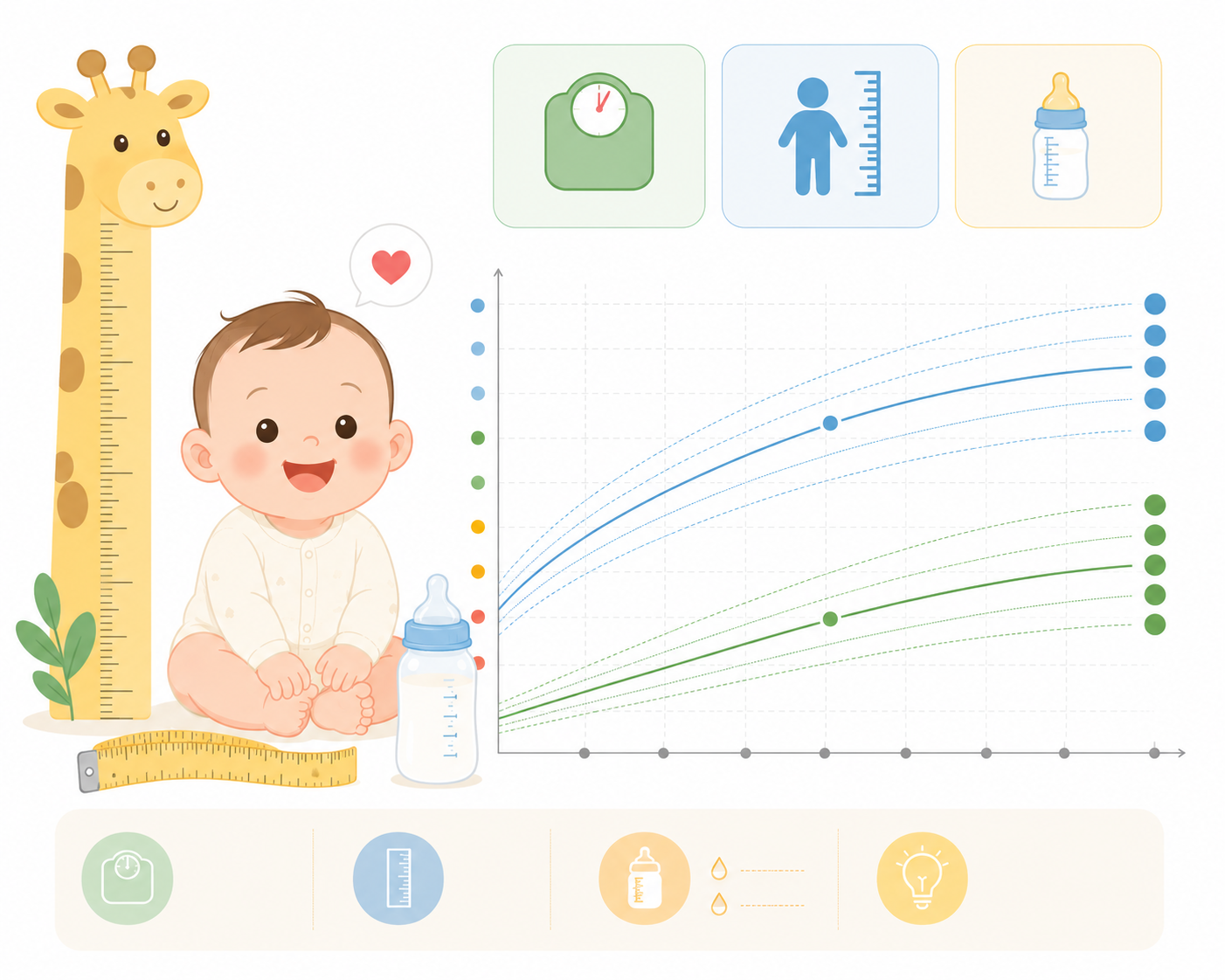
Checking growth charts (e.g., WHO growth curves) and your baby's weight gain helps determine if the feeding amount is appropriate.
If your baby seems calm after feeding and has 6–8 wet diapers a day, they are generally getting enough.
Avoid forcing a shorter or longer feeding interval; instead, adjust the timing based on your baby's hunger signals.
Feeding amount and interval guide
Age | Formula per session (ml) | Feedings per day | Interval (hours) |
|---|---|---|---|
0–1 week | 30~60 | 8~12 times | 2~3 hours |
2 weeks–1 month | 60~90 | 7~9 times | 2.5~3 hours |
1–2 months | 90~150 | 6~8 times | 3~4 hours |
*Since it's hard to measure the exact amount for breastfeeding, please monitor weight gain and diaper count.
Feeding amounts and intervals can vary slightly every day. Babyfolio is a parenting record app that allows you to manage baby photo sharing, growth tracking, and feeding schedules all in one place. By recording feeding times and amounts, you can easily check your baby's routine and keep track of their progress alongside their growth photos.
It may help to consult a specialist when...
We recommend consulting a pediatrician if your baby continues to cry after feeding or if weight gain is slow compared to growth charts. It's also good to get professional advice if feeding intervals are excessively short or long.
Frequently Asked Questions (FAQ)
Q1. Is it okay if my baby gets hungry before the scheduled time?
Yes, your baby's signals are most important. Don't force them to wait just to stick to a schedule; feed them when they need it.
Q2. Is it okay if the feeding amount is more than what the growth chart says?
Every baby is different. As long as their weight and height are increasing appropriately, it's usually fine. However, if weight gain is too rapid, please consult a doctor.
Q3. When should I reduce night feedings?
After 2–3 months, if they are eating enough during the day and gaining weight well, you can gradually try to reduce the number of night feedings.
In summary
While referring to growth charts, weight gain, and diaper count to adjust amounts and intervals, it is always best to prioritize your baby's individual signals.