Can I Take Tylenol During Pregnancy? 'Just Enduring' Can Be the Riskier Choice
Do you have to endure without Tylenol (acetaminophen) during pregnancy? Major medical societies regard it as the first-line choice for pain and fever, and South Korea's MFDS advises it can be taken within 4,000mg a day for a short period after consultation. Leaving a high fever untreated while just enduring can actually be more dangerous for the baby.
Once you're pregnant, it's hard to reach for medicine even when you have a headache or a fever. Worried that it might somehow harm the baby, many people just tough it out whenever they can. And with all the talk going around about Tylenol lately, some of you may be feeling even more cautious.
Let's start with the bottom line. Even during pregnancy, acetaminophen (Tylenol) is regarded by major medical societies as the first medication to consider for pain and fever. The American College of Obstetricians and Gynecologists (ACOG) and the Society for Maternal-Fetal Medicine (SMFM) point to acetaminophen as the first-line pain reliever and fever reducer in pregnancy, and South Korea's Ministry of Food and Drug Safety (MFDS) likewise advises that taking it for a short period, within the set dosage and after consulting a doctor or pharmacist, is possible.
So the idea that "you have to endure everything without medicine once you're pregnant" is, in fact, closer to a misconception. If anything, leaving a high fever or severe pain untreated and simply enduring it can be more dangerous for the baby. In this article, we'll go through, one by one, why that misconception took hold, roughly how far the safe range extends, and which principles you'll want to keep. That said, let's note upfront that with any medicine, consulting your obstetrician or pharmacist before taking it is the basic starting point.
"Pregnant women have to endure without any medicine" — where did this idea come from?
There's a reason for this misconception. During pregnancy, there really are medicines you should avoid or be careful with. Notably, anti-inflammatory painkillers (NSAIDs) such as ibuprofen, as well as aspirin, can affect the fetus's kidney function or heart and blood vessels, especially in late pregnancy, so the principle is to limit or avoid them. Because "medicines to be careful with" clearly do exist, it somehow got lumped together into "no medicine is okay for pregnant women."
But you can't treat "medicine" as one single lump. The safety evidence differs from one ingredient to another. Acetaminophen has been widely used in pregnant women for a long time, and major medical societies still recommend considering it first when pain relief or fever reduction is needed during pregnancy. In fact, ACOG reaffirmed in 2025 that acetaminophen is the safest first-line pain reliever and fever reducer in pregnancy.
To sum up: "you shouldn't carelessly take just any medicine during pregnancy" is true, but stretching that into "so you must endure without acetaminophen too" is a bit different from what the evidence says. It's better to keep in mind — as separate things — what to be careful with, and what you can use when you need it.
Just enduring can actually be the more dangerous choice
This is the part many people overlook. When you focus only on avoiding medicine, the danger posed by the untreated symptom itself tends to slip out of view.
What deserves particular care is a high fever. The Society for Maternal-Fetal Medicine (SMFM) views an untreated maternal high fever during pregnancy — especially in early pregnancy — as a factor that can raise the risk of fetal malformation or miscarriage. The MFDS likewise advises that if a fever of 38°C or higher persists in early pregnancy, it can affect the fetal nervous system, so when symptoms are severe, an acetaminophen-based fever reducer and pain reliever may be taken. In other words, enduring a fever no matter what may not be the way to protect the baby.
The same goes for pain. Leaving a severe headache or pain unaddressed for a long time can worsen your overall condition — poor sleep, not eating properly, and so on. What's more, rather than enduring and enduring until you reach for a different painkiller, using acetaminophen — for which relatively more safety evidence has accumulated — within the guideline range is often the better choice. The feeling that "enduring is a virtue" is understandable, but it's worth remembering together that toughing it out is not always the safe option.
So how far is okay?
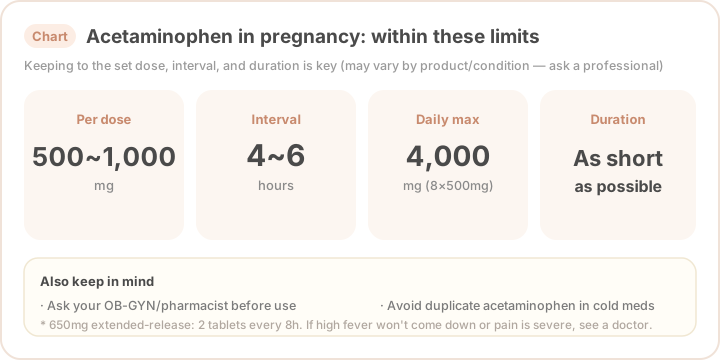
Let's organize the dosage guidance you're probably most curious about. The broad principle the MFDS advises is: "after consulting a doctor or pharmacist, within the set dosage, for a short period." We've gathered the dosing commonly described for adults into a table. Keep in mind, though, that this is only a general guideline — judgment suited to your individual condition requires a consultation with a professional.
| Item | General guideline |
|---|---|
| Single dose | 500–1,000mg (1–2 tablets, based on 500mg tablets) |
| Dosing interval | 4–6 hours |
| Maximum per day | Within 4,000mg (8 tablets a day, based on 500mg tablets) |
| Duration | The shortest period needed to relieve symptoms (short term) |
| Extended-release (650mg) | 2 tablets at a time, at 8-hour intervals |
| Shared premise | Consult your obstetrician or pharmacist before taking |
The key points here are "within 4,000mg a day" and "short term." Using it briefly within the set amount when fever or pain is severe falls within the range that both the medical societies and the MFDS recognize, but exceeding the dose or taking it habitually over a long time is a different matter. If symptoms continue or recur for more than a few days, rather than increasing the dose it's right to see a doctor and look into the cause.
Even so, please do keep these principles
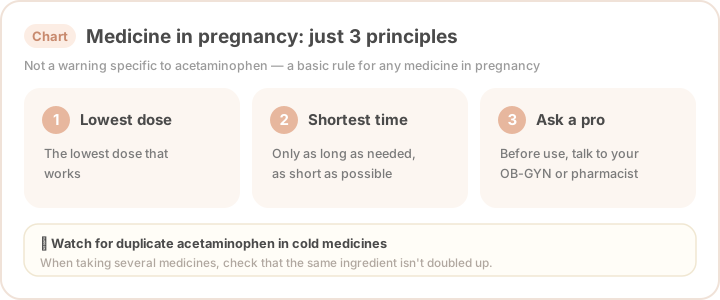
"Can be taken" doesn't mean "you can take as much as you like." The principles below are ones the medical societies and the MFDS emphasize in common, so it's good to keep them in mind together.
The lowest effective dose, for the shortest time, is the basic rule. Make it a principle to use the smallest amount that can manage the symptoms, for the shortest time. In particular, weeks 5–11 of pregnancy is when the fetus's various organs are forming, so it's better to approach it more carefully.
Consultation comes first, before taking. The judgment can change depending on your current gestational week, other conditions you have, and medicines you're taking alongside it. So rather than deciding on your own, it's safer to consult your obstetrician or pharmacist once before you start.
Watch out for duplicate ingredients in combination cold medicines. Many over-the-counter multi-symptom cold remedies or painkillers already contain acetaminophen. If you take Tylenol separately while also taking a cold medicine, you can end up exceeding the daily recommended amount without realizing it. When using several medicines together, it helps to build the habit of checking the ingredient list or asking a pharmacist whether any ingredients overlap.
You've heard the claim that it "causes autism," right?
Recently, with talk spreading that Tylenol in pregnancy "may cause autism or ADHD," many of you may have felt anxious. To put the conclusion first: the research to date and the major medical societies hold that a causal relationship between taking acetaminophen and autism or ADHD has not been proven. ACOG and several other organizations reaffirmed the same position in 2025.
Why this controversy began, what studies it was based on, and how they were rebutted is a topic with too much nuance to cover briefly. We've organized the details separately in The Tylenol "causes autism" controversy in pregnancy — what's the truth?, so if this part in particular worries you, we recommend reading on. And if you're curious why different organizations seem to take slightly different positions, Tylenol in pregnancy: what do the medical societies and agencies say? may also help.
Consult your obstetrician or pharmacist in these cases
Apart from knowing the information, in the following cases it's safer to consult a professional rather than judging on your own.
- When fever or pain continues for more than a few days or keeps recurring
- When a fever of 38°C or higher won't come down easily
- When symptoms don't improve even after taking it within the guideline dose
- When you're taking a cold medicine or other drugs together and worry ingredients may overlap
- When you have a chronic condition or are steadily taking other medications
- When you can't judge for yourself how much is okay to take
A persistent high fever in particular is a situation where the symptom itself can affect the fetus, so seeing a doctor is better than waiting it out. Simply checking once with your obstetrician or pharmacist when deciding whether and how to take it will put your mind much more at ease.
Frequently asked questions
Q. I'm in early pregnancy and have a bad headache. Can I take Tylenol?
Being in early pregnancy doesn't mean you must endure it no matter what. That said, the early stage is a sensitive time when the fetus's organs are forming, so it's better to approach it more carefully. If your symptoms are severe, rather than taking it on your own judgment, tell your obstetrician or pharmacist your current gestational week and condition, and discuss whether to take it.
Q. If acetaminophen isn't an option, can I take a different painkiller?
Anti-inflammatory painkillers (NSAIDs) such as ibuprofen, as well as aspirin, can affect the fetus's kidneys or heart and blood vessels during pregnancy — especially in late pregnancy — so the principle is to limit or avoid them. That's why acetaminophen tends to be considered first when pain relief or fever reduction is needed in pregnancy. If you're in a situation that calls for a different medicine, be sure to consult a professional.
Q. I'm taking a multi-symptom cold medicine — can I take Tylenol separately as well?
Multi-symptom cold remedies and painkillers often already contain acetaminophen. Adding Tylenol on top in that case can push you over the daily recommended amount. Before combining them, it's safer to check the ingredient list or ask a pharmacist whether any ingredients overlap.
To wrap up
Even during pregnancy, acetaminophen (Tylenol) is regarded by major medical societies as the first-line choice for pain and fever, and the MFDS advises that using it within 4,000mg a day for a short period, after consulting a doctor or pharmacist, is possible. The idea that "pregnant women must endure without any medicine" is closer to a misconception, and if anything, leaving a high fever or severe pain untreated can be more dangerous for the baby. A high fever in early pregnancy, in particular, is itself a sign to be careful about. In exchange, please do keep the principles of lowest dose and shortest duration, consultation before taking, and caution about duplicate ingredients in combination cold medicines. And whenever a medicine is hard to decide on by yourself, consulting your obstetrician or pharmacist first is the safest path.