Head Control and Rolling Timeline: When It Starts, Month by Month
Head control and rolling—is your baby on track? We lay out the timing month by month from 1 month to beyond 6 months in one table, plus normal variation and signs worth checking.

"She's almost 100 days old but still can't hold her head up well." "The baby next door is already rolling over—when will ours?" In the first few months, head control and rolling are the milestones parents wait for most eagerly. So it's easy to feel anxious and keep comparing your baby to others.
Let's start with the big picture. Head control usually begins around 1–2 months, when a baby briefly lifts the head while on the tummy; by about 3 months they lift it 45–90 degrees, and by 4–5 months they usually hold it steadily. Rolling typically starts between 4 and 6 months—some babies roll as early as 3 months, others not until after 7 months, and both are within the normal range.
And this stage varies a great deal from baby to baby. The table below lays out the flow by month; find the row for your baby's age first, but treat the timing as a wide range rather than a fixed answer.
Head control and rolling: roughly when, by month?
Here it is at a glance—a table of how head control and rolling connect from 1 month to beyond 6 months. Find the row that matches your baby's age.
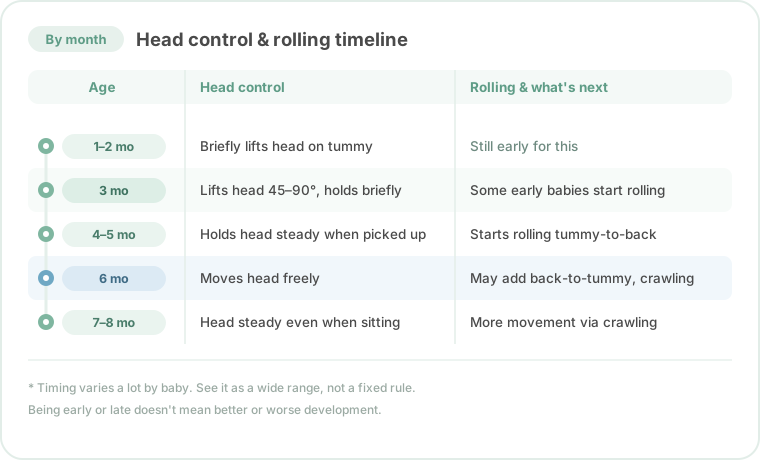
| Age | Head control | Rolling & what comes next |
|---|---|---|
| 1–2 mo | Briefly lifts the head a little when on the tummy | Still early for this |
| 3 mo | Lifts the head 45–90° on the tummy and holds it briefly | Some early babies start rolling |
| 4–5 mo | Head no longer falls back much when picked up; holds it steadily | Often starts rolling tummy-to-back around now |
| 6 mo | Moves the head freely | May add back-to-tummy rolling and belly-crawling |
| 7–8 mo | Head is steady even when sitting | More movement via belly-crawling or crawling |
The table shows how rolling tends to begin once head control is fairly settled. That said, the stages overlap in many babies, and being early or late doesn't mean better or worse development. Use the table as a big-picture guide, and watch your own baby's pace separately.
Head control: what stages lead to it?
Head control doesn't happen overnight—it develops in stages over several months as the muscles grow. At first a baby only lifts the head briefly, then gradually holds it longer and higher.

1. 1–2 months: briefly lifting the head
Around this age, a baby lifts the head just a little while on the tummy and soon lowers it again. The neck and back muscles aren't mature yet, so it can't be held long, but this brief lift is the first step toward head control.
2. Around 3 months: lifting 45–90°
By about 3 months, a baby can lift the head close to 45–90 degrees while on the tummy and hold that position briefly. The 100-day mark falls roughly here, so think of it less as head control being "complete" and more as strength really starting to build.
3. 4–5 months: holding it steadily
Around now, when you pick the baby up the head no longer falls far back and the baby supports it to some degree. "Holding the head steadily" usually refers to this stage. From here, holding the baby upright feels much more comfortable too.
4. From 6 months: moving it freely
By about 6 months a baby moves the head freely and supports it well even when seated. This strength becomes the foundation for the next milestones—rolling, sitting, and belly-crawling.
Rolling: when, and in what order?
Rolling usually begins between 4 and 6 months. Some babies roll at 3 months, others only after 7 months, and both fall within the normal range when viewed broadly. More important than the start date is whether the baby is beginning to twist the body and try to use its strength.

As for the order, babies usually roll from tummy to back first—twisting from a face-down position onto their back. The reverse comes next: rolling from back to tummy, which often appears a bit later than the first direction.
One thing worth knowing: once rolling first appears, don't leave your baby alone on a high surface. Around this time it's common for a baby who couldn't roll yesterday to suddenly roll and fall off a sofa or bed.
After rolling, what develops next?
As rolling and rolling back become familiar, a baby's world keeps expanding. A baby who used to just lie down now changes direction on its own and soon shows the urge to move toward where it wants to go.
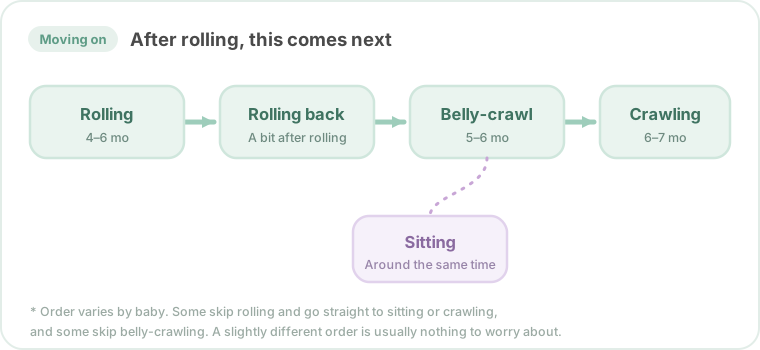
Belly-crawling—dragging the body along with the tummy on the floor—usually starts around 5–6 months, and after 6–7 months it leads to crawling on hands and knees. Sitting also settles in around a similar time.
That said, not every baby follows this order exactly. Some babies skip rolling almost entirely and go straight to sitting or crawling, and some go to crawling without belly-crawling. A slightly different order is usually nothing to worry about—it's just each baby using its body in the way that suits it.
Why is it natural for babies to differ?
At the same age, one baby may already be rolling while another is still working on head control. This isn't a matter of better or worse development—only a difference in pace and order. Many factors, such as gestational age at birth, temperament, weight, and how much tummy time a baby gets, all work differently for each child.
Rolling or gaining head control early doesn't mean a baby will walk better or be smarter later, and being a little late doesn't mean falling behind. For babies born prematurely in particular, it's more accurate to use corrected age based on the original due date; comparing by calendar age alone tends to cause needless worry. So rather than "at X months a baby must do Y," it's easier on the mind to watch development as a wide range.
How to manage tummy time and a safe sleep space
The muscles behind head control and rolling grow largely during tummy time—playing face-down while awake. When your baby is happily awake, letting it play on its tummy in short, frequent sessions builds the neck, back, and shoulder muscles. It may struggle with even a few minutes at first, so increase it little by little. For how to start and build up tummy time, see our guide to tummy time and developmental milestones.
One thing to keep clearly separate: tummy play is only when your baby is awake and you're watching nearby. For sleep, always place your baby on its back, and avoid putting it to sleep on its tummy. Because sleeping face-down can be risky while rolling is still new, it's safest to lay your baby flat on its back on a firm, flat surface for sleep.
When to check with your pediatrician
Because the timing range is wide, being a little early or late is usually nothing to worry about. Still, if you notice signs like the ones below, it's better to check with a pediatrician or a well-baby visit rather than deciding on your own.
- Barely lifting the head on the tummy even after 4 months
- The head continuing to fall far back when picked up
- No sign at all of trying to roll even after 6 months
- Rolling only to one side, or noticeably not using one side of the body
- Being excessively stiff, or conversely very floppy and limp
- Losing head control or rolling that the baby used to do
For which signs to watch and when to seek care if you're worried about development, we cover more in When development seems slow: when should you see a doctor?. Regular well-baby checkups also review development, so it's reassuring to raise any questions there.
Recording those first milestones is worth it
Head control and rolling are moments that easily blur into "when was that again?" once they've passed. Jotting down the date of each first—first head control, first roll—as it happens makes it easier to look back on your baby's development later and to describe when things started at checkups.
If you keep these moments as growth records with photos in Babyfolio, grandparents and family who live far away can also see your baby's first roll and share the joy through comments. It's a way for the whole family to celebrate those first milestones together.

Frequently asked questions
My baby is past 100 days but still can't hold the head up at all. Is that late?
100 days is roughly 3 months, so at this point head control is still building rather than complete. Holding it steadily usually comes at 4–5 months, so it's fine to watch a bit longer; but if your baby barely lifts the head on the tummy, check at your next visit.
My baby keeps rolling only to one side. Is that okay?
Many babies roll only in their easier direction at first. Most come to do both over time, but if your baby noticeably doesn't use one side of the body or keeps leaning to one side, it's a good idea to have a pediatrician take a look.
My baby rolls over but can't get back and cries. What should I do?
This is common in the stage when rolling works but rolling back doesn't yet. The baby cries out of frustration, so just change its position nearby. Rolling back often appears a little later than rolling, so give it time.
My baby skips rolling and tries to sit straight away. Is that a problem?
Developmental order varies by baby, and some barely roll and move on to sitting or crawling. A different order itself is usually nothing to worry about, but if other movements also feel slow, it's worth asking at a checkup.
In summary
Head control begins with brief head lifts at 1–2 months, reaches 45–90° at 3 months, becomes steady at 4–5 months, and grows free by 6 months. Rolling usually begins between 4 and 6 months—within the normal range even if as early as 3 months or after 7 months—and then leads to rolling back, belly-crawling, and crawling.
Above all, remember that it's natural for babies to differ in pace and order at this stage. Early and late aren't better and worse. Support the muscles with tummy time, but always put your baby to sleep on its back, and when you're worried about development, checking with the related articles, well-baby visits, and a pediatrician brings real peace of mind.