What to Check First When a Newborn Cries | A 5-Step Order
Crying and can't tell why? Instead of straining to guess the cause by sound, we lay out a practical check flow that rules out common reasons one by one, hunger → diaper → sleepy → temperature → holding, plus soothing methods and warning signs for when it won't stop.

When your baby is crying their heart out and you have no idea why, trying to decode the sound first tends to make you feel even more rushed. You can listen hard for "is this a hungry cry or a hurting cry," but newborn crying just doesn't split apart that cleanly.
So the faster path isn't guessing the sound, it's an order. You take a few common reasons a baby cries and check and rule them out one by one, in a set sequence. Going hunger → diaper → sleepiness → temperature and clothing → holding, you usually land on the answer within that list even without knowing exactly why.
In this article, we've laid out a 5-step check order that rules out common causes one at a time, plus ways to soothe when you've done every step and the crying continues, and the signs that mean you should get to a doctor without delay. Rather than wearing yourself out analyzing the sound, holding one concrete order in hand is far more reassuring.
Even if you don't know why, ruling out the common ones usually stops it
First, some reassuring news. A newborn crying isn't strange; it's the only way your baby has to communicate. They express hunger, a wet diaper, sleepiness, and heat all through crying. So you can set down the pressure of "I have to know why before I can soothe."
Getting a sense of how much crying is common makes things much easier. Up to about 3 months, crying 2 to 3 hours a day isn't unusual, and it tends to follow a pattern of peaking around 6 weeks and gradually easing from about 12 weeks. In other words, even if it feels like a lot of crying right now, it may be a natural, age-related stretch.
Here's the key point: even if you can't pin down the cause by sound, working through the most likely reasons in order usually settles it within that list. Rather than straining to make an exact diagnosis, ruling out common candidates one by one gets the baby comfortable faster and lowers parent stress too. If you'd like to tell signals apart more finely by the sound and gestures of the cry, take a look at how to read signals by cry sound and gesture as well. But today, the weight is on "order," not "guessing."
Start with the common ones — the 5-step check order
Now for the practical part. Just work through the five below from the top, in order. The earlier steps are the more common reasons, so simply checking in order usually stops the crying somewhere in the middle.
1. Hunger — start with the most common reason
The most common reason for crying is hunger. First, think back to when the last feed was. If it's been a while, hunger is likely. If you lightly touch a finger or nipple near the mouth and the baby turns and tries to suck (rooting response), or brings a hand to the mouth, it may be a hunger signal. If newborn feeding intervals and amounts feel confusing, setting a baseline with the newborn feeding amount, interval, and weight-gain guide speeds up this step.
2. Diaper — is it wet or uncomfortable?
If it hasn't been long since a feed, the diaper is next. Check whether it's wet or soiled, and look for any chafed or red, raw spots too. This is also a good time to check whether the diaper band is squeezing the belly, or a seam or tag on the clothing is pressing into the skin.
3. Sleepy or tired — crying because they can't sleep
If the baby is fed and dry but still crying, they may be fussing because they're sleepy but can't drop off. Newborns actually find it harder to fall asleep the more tired they get, so when they rub their eyes, yawn, and look away yet still can't sleep, it can spill out as crying. If they've been awake a long while, shift toward reducing stimulation and settling them in a quiet setting.
4. Temperature and clothing — too warm or too cold?
Babies cry when they're too warm or too cold. It's easy to overdress by adult standards, so feel the back of the neck or the back with your hand; if it's damp with sweat, they're warm. Conversely, if the torso, not the hands and feet, feels cool, they're a bit cold. Hands and feet are normally a little cool, so use the neck and back as your temperature gauge. Adding or removing a single layer stops the crying surprisingly often.
5. Holding and burping — wanting to be held or feeling unsettled
If you've checked all of this and the baby is still crying, they may simply want to be held and feel secure. Many babies settle when you hold them close against your chest and sway gently. After a feed, it may be discomfort from a burp that won't come, so rest them upright against your shoulder and gently stroke up the back to help bring up a burp.
Here it is summarized in order at a glance.
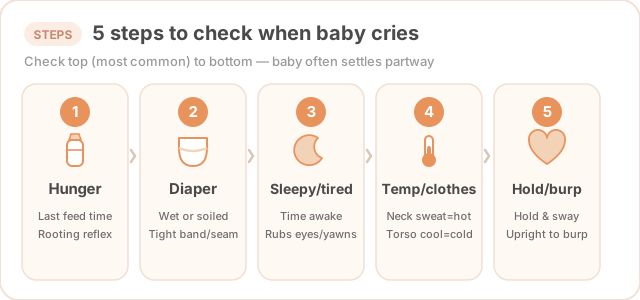
| Order | What to check | How to look |
|---|---|---|
| 1 | Hunger | Check last feed time, rooting response, sucking on hands |
| 2 | Diaper | Wet or soiled, raw skin, tight band or clothing seams |
| 3 | Sleepy/tired | Time awake, rubbing eyes, yawning, looking away |
| 4 | Temperature/clothing | Neck/back sweat (warm) or cool torso (cold), adjust a layer |
| 5 | Holding/burping | Hold close and sway, hold upright to bring up a burp |
If several steps feel ambiguous even after going in order, don't fixate on one; it's fine to run through from the top again. A baby's state can change within a few minutes.
If you've done every step and it still won't stop
If the baby keeps crying even after all five steps, it doesn't mean you missed something. Stretches of crying without a clear reason are common for a baby at this stage. When that happens, shift your direction from finding the cause to soothing.

The 5 S's soothing method introduced by the American Academy of Pediatrics can help. Using the five together is said to work even better.
- Swaddle: wrap snugly in a thin cloth, including the arms
- Side/Stomach hold: turn the baby slightly to the side in your arms (but always lay them on their back to sleep)
- Shush: make a "shhh" sound near the ear like white noise
- Swing: sway rhythmically with a small motion
- Suck: offer a pacifier to satisfy the urge to suck
If one or two don't do it, try layering several together. The winning combination differs from baby to baby, so think of it as a process of finding what works for yours.
If frantic crying keeps repeating, it may be colic
If you've tried the order and the soothing methods, yet high-pitched, frantic crying repeats around the same time each day, you might suspect colic. It's often remembered as 3-3-3: crying like this for more than 3 hours a day, more than 3 days a week, for more than 3 weeks.
When crying from colic, a baby may pull the legs toward the belly, clench the fists tight, and stay hard to settle no matter how you soothe. It usually eases as the baby grows, but it can really wear out the watching parent. If you'd like to know more about the features of colic, how to respond, and its relationship with feeding, take a closer look at responding to colic and reflux, and a formula guide. That said, if you can't tell colic from something else, or the warning signs below appear alongside it, that's the time to see a doctor without delay.
If you see these signs, see a doctor without delay
If the order above doesn't resolve things and even one of the signs below appears, rather than continuing to soothe at home, get to a pediatrician or emergency care right away. This isn't a matter of order; it's a matter of time.
- A fever of 38°C (100.4°F) or higher, or the body going limp
- Repeated vomiting of feeds, or ongoing forceful, projectile vomiting
- Blood in the stool — especially if the baby cries frantically then quiets in cycles about every 5 to 15 minutes, suspect intussusception and check quickly
- Signs of dehydration, such as a sharp drop in urine and a dry mouth
- Weight not gaining and stalled
- Hard crying that won't stop for more than 30 minutes, or crying clearly different from usual
Above all, a parent's instinct that "this is different from usual" matters. Even if you can't put your finger on it, if something feels off, it's more reassuring to trust that feeling and get it checked.
Jotting down what you checked makes next time faster
If running through all five steps from the start every time feels like a lot, it helps to leave a short note of what you checked when the baby cried. Just recording when the last feed was, when you changed the diaper, and what time you put the baby down lets you skip earlier steps next time, thinking "at this time of day it's probably hunger," and respond faster.
Keeping notes like these in Babyfolio as feed and care memos makes the patterns by time of day visible, so it's easy to prepare ahead: "around now is when they get hungry." They also become material to show at a visit, capturing when and how the baby cried. Records don't replace your judgment, but they make the next run through the order much lighter.
Frequently asked questions
Can I tell whether it's hunger or pain just from the sound?
It's hard to identify the cause precisely from sound alone. So rather than straining to guess the sound, checking common reasons in order is faster and more reliable. That said, if a high-pitched, frantic cry clearly different from usual appears together with warning signs, medical care is needed.
I'm worried holding will spoil my baby. Can I just leave them?
In the newborn stage, holding is less about forming a habit and more a time of gaining security. Holding a crying baby to calm them is a natural response, so feel free to hold them without worry. That said, temperament varies; some babies settle only when held, and others settle when stimulation is reduced.
Do I have to do all five steps in order every time?
You don't have to go through all five. If the baby stops at a middle step, you can stop there, and if you just fed them, you can skip the hunger step. The order is a broad framework of "most common first," not an absolute rule.
My baby cries especially hard only at night — is that okay?
Many babies have their crying cluster in the early evening or at night. It's a time of day when fatigue and stimulation build up, so it can happen. It's a common pattern, but if the baby cries frantically and long at the same time every day, also consider the possibility of colic, and if you see warning signs, seek advice.
To wrap up
When a newborn cries, rather than straining to guess the cause by sound, it's faster to rule out the common ones one at a time in the order hunger → diaper → sleepiness → temperature and clothing → holding and burping. Even without knowing exactly why, the answer usually turns up within this sequence.
If you've done every step and it still won't stop, switch over to the 5 S's soothing method, and if frantic crying repeats, look into colic too. But if you see a fever, repeated vomiting, bloody stool, dehydration, stalled weight, or severe crying unlike usual, this is no time to work through an order; see a doctor right away. The order is just a handle to steady yourself; whenever your baby feels different from usual, getting a professional's check is always the most reassuring path.