Baby Room AC Temperature | It's Not Always 24°C — How to Tune It to Your Home and Your Baby
Does a baby's room AC really have to be set to 22~24°C? The recommended guide (24~25℃, humidity 40~60%, indoor–outdoor gap within 5℃) is only a starting point. We plainly lay out how to fine-tune by your home's layout and your baby's state, along with cold drafts, humidifying, and ventilation.
On a midsummer night, sitting beside your sleeping baby, you've probably wondered what temperature to set the air conditioner to. "22 degrees? 24? Is that too cold?" You pick up the remote, put it down, pick it up again. Search online and you'll see "just set it to 24" everywhere, yet when you actually try 24 in your own home, sometimes it feels chilly and sometimes still too warm. Confusing, right?
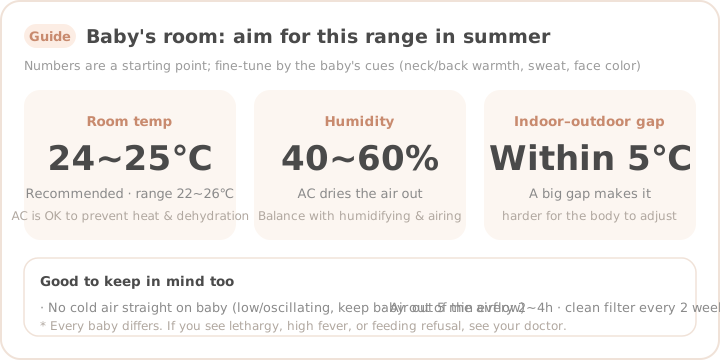
Let's start with the bottom line. A newborn's room is generally around 22~26℃ (24~25℃ recommended), with humidity of 40~60% as a guide. But this is by no means a fixed, one-size-fits-all answer. Your home's layout, where the air conditioner sits, your baby's condition — all of it varies from home to home. So treat the numbers as a starting point, and make the final fine-tuning based on your baby's state (temperature at the back of the neck, chest, and back; sweat; skin color).
One more thing. You can absolutely run the air conditioner in summer — more often than not, running it is the safer choice. A hot environment puts real strain on a baby, with risks like heat illness, dehydration, and disrupted sleep. In this article, we'll gently work through "why there's no fixed number" and "what to actually go by instead."
What's a good guide for a baby's room temperature?
Let's sort out the number you're most curious about first. For a room where a newborn spends time, 22~26℃ is the range, and within that, around 24~25℃ is the recommended zone. For humidity, 40~60% is a comfortable range. Too dry and the nose and skin get parched; too humid and mold or heat rash can develop more easily, so staying within this band is ideal.
The table below lays it out at a glance. Just remember first that this table is a "reference line," not a "fixed answer."
Category | Reference range | Recommended |
|---|---|---|
Indoor temperature | 22~26℃ | 24~25℃ |
Indoor humidity | 40~60% | around 50% |
Indoor–outdoor temp gap | within 5℃ | — |
Where to check temperature | back of neck, chest, back | (hands and feet aren't a guide) |
Why isn't "just set it to 24" the right answer?
This is where the heart of the article begins. The very same 24 degrees can feel completely different in your home versus your neighbor's. Why is that?
First, the layout of your home differs. A home where the air conditioner sits right above the baby's crib and a home where the living-room air conditioner's breeze drifts in through the doorway will give the baby a totally different sense of coolness at the same setting. Ceiling height, window direction, and insulation also make the actual temperature vary from room to room. There's no guarantee that the 24 shown on the remote is the 24 your baby feels up on the bed.
Babies themselves are all different, too. A chubby baby and a slim baby, a baby who sleeps soundly and a baby who runs warm — each is comfortable at a slightly different temperature. Pediatric specialists, too, tend to explain that rather than fixating on a single number, you should watch whether your baby seems comfortable. In the end, the reference number only tells you "where to start" — it doesn't nail down "this is the finish line." So the approach that actually fits best is to set it to 24, watch your baby, and nudge it up or down a little at a time.
An indoor–outdoor gap of 5 degrees — why does it matter?
There's one more thing to consider when deciding on a temperature: the difference from the outside temperature. You'll often hear "keep the indoor–outdoor gap within 5℃," and there's a reason for it.
Every time our bodies move between hot and cool places, the autonomic nervous system works hard to adjust our temperature. Even adults feel sluggish or get headaches when the gap is large. A baby's ability to regulate this is still immature, so a sudden temperature swing can be harder on them. That's why, rather than dropping the room all the way to 20℃ just because it's 33℃ outside, keeping the gap gently around 5℃ tends to be easier on the body. It can also help ease the kind of discomfort people call "air-conditioning sickness."
That said, this isn't an absolute rule either. On days of severe heat, keeping within 5℃ may be difficult — and when that happens, prioritize keeping your baby from getting too hot over the temperature gap. There are situations where it's better to stay cool, even with a somewhat larger gap, than to have your baby struggling in the heat. "Don't get boxed in by the numbers" applies here as well.

Make the final adjustment by reading your baby
Once you've matched the reference numbers and the temperature gap, make the final fine-tuning by looking at your baby's body. This is a more accurate gauge than any fixed number.
The places to check are the back of the neck, the chest, and the back. Hands and feet are naturally a bit cool, so judging that your baby is cold because their hands are cool can lead you to overdress them by mistake. Slip your hand gently against the back of the neck or the back: if it's damp with sweat, that's a sign they're warm — lower the temperature a touch or dress them lighter; if it's cool and a little chilly, raise it slightly or add a thin long-sleeved layer.
Skin color is a hint, too. If the face is unusually flushed and your baby tosses and can't sleep well, they may be on the warm side; if the lips look pale and they curl up, they may be on the cold side. When you use the signals your baby's body sends as your guide, you can find the temperature that suits your own child without clinging to the number on the remote.
Cold drafts, humidifying, ventilation, filters — a quick word
As much as temperature, people often ask about airflow and air quality. Let's cover just the essentials.
Keep the cold draft off your baby directly. Use a low fan speed, and set the louvers to swing or point upward so your baby stays out of the airflow path. You don't turn the air conditioner off — you just redirect the breeze.
Cover the belly and body with a thin long-sleeved layer or a swaddle. Even in a cool room, an exposed belly chills easily.
Use a humidifier to keep humidity in range. Running the air conditioner tends to dry the air, so keeping it between 40~60% helps the nose and skin stay less parched and more comfortable.
Open a window to ventilate for at least 5 minutes every 2~4 hours. This swaps out the stale air of a closed room.
Clean the filter about once every 2 weeks. A buildup of mold or dust can affect the airways and allergies.
If your baby seems, oddly, more congested or listless in a cool room, you may start wondering about air-conditioning sickness. For how it differs from a summer cold, we sorted out the distinctions in is it air-conditioning sickness or a summer cold?. And if the heat itself is your worry, don't drape cloth over a summer stroller may also help.
When to seek advice
Even when you've dialed in the air conditioning well, if your baby's condition seems off, don't chalk it up to the environment alone — take a closer look.
In particular, for young babies under 3 months, and especially under 1 month, it's best to seek care promptly at even a rise in temperature (fever) alone. In young babies, the situation can change quickly while you're waiting for other symptoms to appear. Rather than assuming the fever is just from the cooling and watching to see, treat fever itself as a reason to seek care at this age.
Regardless of age, if your baby becomes limp, isn't feeding well, vomits repeatedly, has a noticeably reduced number of wet diapers, or is breathing differently than usual, it's safer to seek care quickly. These signs can show up a little differently from baby to baby, so when it's unclear, checking with your pediatrician rather than waiting will also put your mind at ease.
Frequently asked questions
Q. Is it OK to leave the air conditioner on all night while my baby sleeps?
If you keep an appropriate temperature and humidity and make sure the cold draft doesn't hit your baby directly, leaving it on overnight isn't dangerous in itself. In fact, on a sweltering night, a room that's too hot makes it easy for a baby to sleep poorly and lose fluids through sweat. That said, the temperature drops toward dawn, so rather than leaving your bedtime setting untouched, it's good to check on your baby once and raise the temperature a little or add a thin layer.
Q. Can I run the air conditioner and an electric fan together?
Using them together spreads the cool air evenly through the room, so you don't have to lower the setting too much. Just aim the fan's breeze at a wall or the ceiling rather than directly at your baby, and turn on the oscillation so the airflow doesn't concentrate in one spot.
Q. Do I really need to buy a thermo-hygrometer to know the right temperature?
Being able to see the numbers does make adjusting much easier. Especially in a home where temperature varies from room to room, placing a thermo-hygrometer near your baby's crib helps. Still, rather than trusting the device's numbers alone, the surest gauge in the end is the habit of feeling the back of your baby's neck and back.
Q. I worry my baby will catch a cold if I run the air conditioner.
Being cool itself doesn't cause a cold. What can be hard on a baby, though, is a sudden temperature gap, dryness, or a cold draft hitting them directly. Keeping the temperature gap gentle, staying on top of humidifying and ventilation, and keeping the breeze off them can ease that strain.
To wrap up
For a baby's room, 22~26℃ (24~25℃ recommended), humidity 40~60%, and an indoor–outdoor gap within 5℃ make a good reference line. But this is a starting point, not a fixed answer. Home layouts, air-conditioner placement, and a baby's condition all differ, so the final adjustment is most accurate when you go by the temperature at the back of the neck, chest, and back, along with sweat and skin color. In summer, running the air conditioner is more often the safer choice — just keep the cold draft off your baby directly, and along with that, look after a thin long-sleeved layer, humidifying, ventilation, and filter cleaning. And if a baby under 3 months develops a fever, or a baby of any age becomes limp, won't feed, vomits, or breathes abnormally, don't delay in seeking care. Don't get boxed in by the numbers — tune it to your own child, and that's the right answer for your home.