Baby's first foods: what to start with, and the rice porridge → veg → fruit → beef order
What should baby's first food be? A step-by-step guide to the order of foods — rice porridge → vegetables → fruit → beef — plus how to watch each new food for 3–5 days, and how thin, how much, and how to feed in early weaning.

When it's time to start solids, the excitement often comes with just as many questions. "So what do I feed first?" You hear there's an order — rice porridge first? Can you give fruit? When does beef come in? The more you look, the more the advice seems to differ, which can make it even more confusing.
Here's the big picture first: the very first food in early weaning is usually rice porridge (rice gruel). After that, a good basic guide is to widen foods in the order vegetables → fruit → protein such as beef. And whatever the food, the key is to add it one at a time, watching for about 3–5 days.
That said, this order is less a hard rule than a widely suggested guide. Every baby eats a different amount and accepts food at a different pace. In this article we've laid out, in order, how to introduce foods, how to watch each new food, and how thin and how much to start with. If you're still wondering whether it's even time to start, you might read Signs your baby is ready for solids first.

Why start with rice porridge?
Rice porridge is the most commonly suggested first food in early weaning. Rice has no gluten and tends to be low in allergy risk, so it's gentle for a baby whose digestion is still developing to try first.
Start the first rice porridge very smooth and thin — watery, like the "10-to-1" porridge people often mention. At first the goal isn't nutrition so much as practicing eating from a spoon and getting used to a new texture. A baby's main nutrition at this stage still comes from breast milk or formula, so if your baby leaves some or refuses, there's usually no need to worry too much.
Once your baby is fairly used to rice porridge, you add vegetables one at a time to widen the range. Just remember that rice porridge comes first, and the order after that becomes much easier to follow.
The order to introduce foods: rice porridge → vegetables → fruit → beef
The basic order for widening foods is grain (rice) → vegetables → fruit → protein (such as beef). There's a reason behind this order, and it makes sense when you look at each step. Keep in mind this is a guide to refer to, and it may be adjusted based on your baby and your pediatrician's guidance.
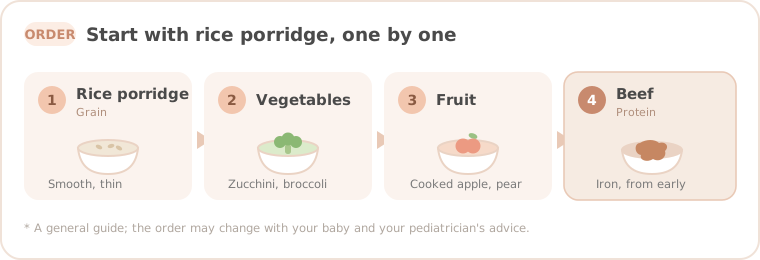
1. The very start — rice porridge (grain)
First comes rice porridge. Low in allergy risk and easy to digest, it has become the go-to first food. Start it finely ground and thin, and continue for a few days while watching how your baby takes it.
2. Next, vegetables
Once your baby is used to rice porridge, add vegetables one at a time. Many parents start with mild, easy-to-digest vegetables such as zucchini, broccoli, and bok choy. There's a reason vegetables come before fruit, and it leads into the next step.
3. Then fruit
Fruit is usually suggested after vegetables. If a baby gets used to the sweetness of fruit first, they may be less willing to accept the milder taste of vegetables — so adding fruit after some experience with vegetables tends to work well. Start with small amounts of fruit cooked soft, such as apple or pear.
4. Beef, earlier than you'd think
It's easy to think "meat comes later," but beef is actually good to include from early on. The iron a baby stores before birth gradually runs lower around 6 months of age. To top up iron, adding beef — a red meat — during the early weaning stage is recommended. Finely grind or mince it and, like any other food, start with small amounts while watching.
Introduce each new food one at a time, and watch for 3–5 days
The most important principle when introducing a new food is to give it one at a time. You give a single new food on its own for about 3–5 days, watch your baby's response, and move on to the next food if nothing seems off.
Mixing several foods at once is convenient, but if your baby has a reaction such as a rash, it's hard to tell which food caused it. Giving foods one at a time, spaced out, makes the cause much easier to identify. It's best to give a new food in the morning when possible, since it's easier to watch your baby through the day.
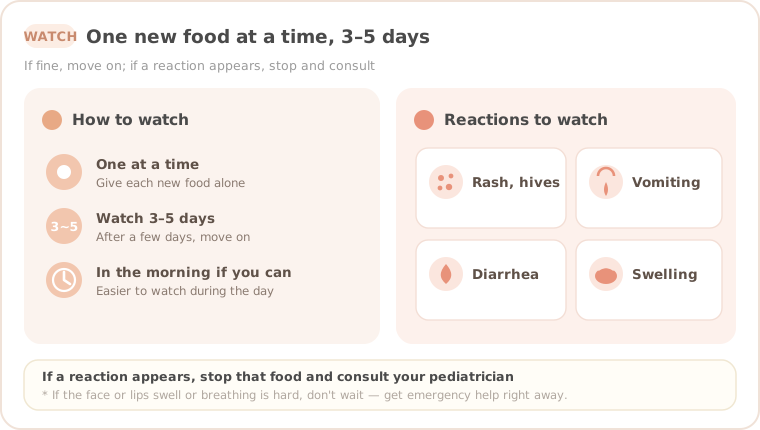
While you're watching, look for reactions such as rash, vomiting, diarrhea, or swelling around the mouth. If you see these, it's best to stop that food and check with your pediatrician. On the other hand, if there's no problem for a few days, that food has become familiar to your baby, and you can move on to the next new one.
Texture, amount, and how to feed
As confusing as the order is the question of "how thin, and how much." Early on, start with a very thin porridge and gradually thicken it as your baby gets used to it. There's no need to make it thick from the start.
Amounts start small too. Begin with a spoonful or two and increase slowly as you see how your baby takes it. Early weaning is about practicing eating rather than filling the tummy, so leaving food or making a face is all part of the process. When feeding, seat your baby upright with the lower back supported, touch the spoon gently to the lower lip, and wait for your baby to take it in.
The table below sums up the texture, amount, and timing of early solids as a rough feel. Treat it as a starting reference rather than a fixed answer. Babies go at different speeds, so there's no need to get tied up in the numbers.
| Item | A rough feel for early weaning |
|---|---|
| Texture | Very thin porridge (about 10-to-1) → thicken gradually as baby adjusts |
| Amount per feed | Start with a spoonful or two → increase slowly by response |
| New food | One at a time, watch 3–5 days (morning if you can) |
| How to feed | Seat upright with support and spoon-feed; main nutrition is breast milk or formula |
Do I have to follow this order exactly?
There's a basic guide, but it's not a rule where a single step out of place is a problem. Let's touch on the two things parents most often wonder about.
First, "Can't I give fruit first?" It's not that you can't — it's just usually suggested after vegetables, because getting used to sweetness first can make vegetables less welcome. If you've already given a little fruit, it's no disaster; just keep offering vegetables alongside going forward.
Second, "Isn't beef for later?" Actually the opposite — as noted, it's good to include early for iron. It's easy to put off because it's meat, but prepared smooth and given in small amounts with watching, it can be started even in the early stage.
When to see your pediatrician
Solids usually go fine if you build up slowly in order, but if you see the signs below, it's safer to check with your pediatrician than to judge alone. In particular, don't brush off reactions that appear after a new food.
- A rash, hives, vomiting, or diarrhea after eating a new food
- The lips, face, or area around the eyes swelling or looking different than usual
- Trouble breathing or going limp after eating solids
- Frequent choking or heavy coughing while swallowing
- The same reaction happening repeatedly with a particular food
In particular, swelling of the face, lips, or tongue, or trouble breathing, can be a severe allergy (anaphylaxis). If this happens, don't wait for an appointment — call your local emergency number right away or go to the emergency room. This article doesn't cover allergy reactions or swallowing (choking) in depth, so if that worries you, it's worth getting guidance tailored to your baby from your pediatrician in advance. If repeated vomiting after eating concerns you, Why a formula-fed baby spits up, and what to do may help.
Keeping a record makes watching easier
As you watch each new food one at a time for 3–5 days, it's easy for memories to blur — "when did I first give this vegetable?", "wasn't there a little rash that day?" Jotting down the date you gave a new food and your baby's response, as you go, makes it much easier later to pin down which food caused a reaction.
This is where keeping a feeding log in Babyfolio helps: you can collect the date you gave each new food and that day's response, along with photos, bit by bit. When you later talk with your pediatrician, you can show "what was eaten when, and how it went" right away, so the conversation goes much more smoothly.
Frequently asked questions
Can I give something other than rice porridge as the first food?
Rice porridge is often suggested first because it's low in allergy risk and easy to digest, but depending on your baby, some start with another grain. If you're unsure what to give first, it's a good idea to get guidance suited to your baby from your pediatrician.
My baby is a bit fussier on the day I give a new food. Is it an allergy?
Fussiness has many causes, so that alone doesn't point to an allergy. But if it comes with reactions like a rash, vomiting, diarrhea, or swelling, stop that food and check with your pediatrician. When it's unclear, it's safest to have a professional see your baby.
I've started solids but my baby keeps spitting it out and barely eats.
Early on, spitting out an unfamiliar texture is common. The main nutrition at this stage is breast milk or formula, so leaving some is usually fine. Try reducing the amount and giving it a few days before trying again. If your baby keeps refusing or you're worried about weight, check with your pediatrician.
Is it really okay to give beef early?
Yes — it's actually recommended from early on to help with iron. Finely grind or mince it and start it like any other new food, one at a time and watching for 3–5 days.
To wrap up
Start solids with rice porridge, then widen foods in the order vegetables → fruit → beef as a basic guide. Beef is good to include early for iron, and the key with any food is to add it one at a time, watching for 3–5 days. Keep the texture very thin and the amount to a spoonful or two at first, then follow your baby's pace.
Above all, remember this order is a guide to refer to rather than a must-follow rule, and that every baby eats a different amount at a different pace. If a reaction like a rash, vomiting, diarrhea, or swelling appears after a new food, stop that food and check with your pediatrician — keeping just this one thing makes starting solids feel much more reassuring.