Baby mosquito repellent: from what age? Icaridin, DEET, and lemon eucalyptus by age
From what age, and what, can you put on a baby for mosquitoes? We lay out the usable ages and safety points for icaridin, DEET, and oil of lemon eucalyptus, plus how to choose an ingredient and apply it safely. Under 6 months, physical barriers are the rule.
When summer comes, the mosquito bites that appear one by one on your baby's arms and legs are hard to ignore. You want to apply a repellent, but you hesitate — "is it okay to use on a baby this small?" The ingredient names are hard, and the usable age differs by product, so it's easy to get confused.
Here's the big picture first: most mosquito repellents on the market open up for use from 6 months of age. Under 6 months, a baby is not a candidate for repellent regardless of ingredient or concentration, and at that stage physical barriers like nets and clothing are the rule. Even after 6 months, the usable age differs by ingredient — icaridin, DEET, and oil of lemon eucalyptus each have different standards.
So this article lays out, ingredient by ingredient, from what age (in months or years) each can be used, what to choose for your baby's age, and how to apply it safely. It also helps to remember that the exact usable age ultimately follows what's printed on the product label (the approved terms of use).

Baby mosquito repellent: from what age?
Most mosquito repellents sold as approved products are labeled for use from 6 months and up. Put the other way, a baby under 6 months is not a candidate for any repellent ingredient. Their skin is still thin and sensitive, and how ingredients absorb differs from adults.
So if your baby isn't yet 6 months, it's safer to set up physical barriers first — a mosquito net, window screens, long clothing, a stroller net — instead of repellent. Mosquito prevention for babies under 6 months is covered in more detail in how to block mosquitoes for newborns and young babies without repellent.
Once past 6 months, it's time to choose an ingredient. But "from 6 months" is only a broad frame; even the same ingredient can carry a different labeled age and concentration by product. When buying a new product, always check that it's an approved product and that the usable age on the label suits your baby.
Usable age differs by ingredient
The ingredients commonly used in mosquito repellents are mainly icaridin, DEET, and oil of lemon eucalyptus. The names may be unfamiliar, but they're not hard one at a time. Each has a slightly different usable age and cautions.

1. Icaridin — often recommended first for young babies
Icaridin (picaridin) is a synthetic repellent ingredient modeled on a compound found in pepper. It has less of a distinctive odor and is gentler on skin than DEET, so icaridin is often recommended first for young babies.
Icaridin, too, is generally not used under 6 months. After 6 months, go by the age printed on the product; for a still-young baby (say 6 months to two years), icaridin tends to be the safer pick over DEET.
2. DEET (diethyltoluamide) — from 6 months, mind the concentration and area
DEET is a long-used repellent ingredient, and some see it as "dangerous," but used at the right age and concentration it's an approved ingredient. For a baby, though, pay special attention to concentration and where you apply it.
As a common guide, products with a DEET content of 10% or less are labeled from 6 months and up, while higher ones (roughly over 10%) are labeled from 12 years and up. The younger the baby, the more the rule is low concentration for a short time, and it's best to avoid the face, hands, and areas with wounds or eczema. Because babies often put their hands in their mouths, it's safer not to apply to the hands. Exact usable age and concentration differ by product, so check the label.
3. Oil of lemon eucalyptus (PMD) — generally from age 3
Oil of lemon eucalyptus is an ingredient (para-menthane-3,8-diol, PMD) made from oil obtained from the lemon eucalyptus tree. It has a "plant-based" image, but its usable age is actually higher.
Products with oil of lemon eucalyptus are often labeled for use from about age 3 (36 months) and up. It can irritate the eyes and skin, so the rule is not to apply it to the face. If your baby isn't yet three, this ingredient may not apply, so here too, check the age on the label first.
4. "Natural" doesn't necessarily mean safe
Some ingredients play up "natural" or "plant-based," like citronella oil or clove oil. But "natural" doesn't automatically mean safer for a baby or more effective.
Some natural-derived ingredients have been subject to regulation because the data supporting their safety and efficacy was not sufficient. So rather than choosing on a "natural" image, it's more trustworthy to check whether it's an approved product and to read the ingredient and age labeling.
Ingredient, age, and safety points at a glance
Here are the per-ingredient guides in a table. The ages below are a broad guide; for the actual usable age, look first at the product label.
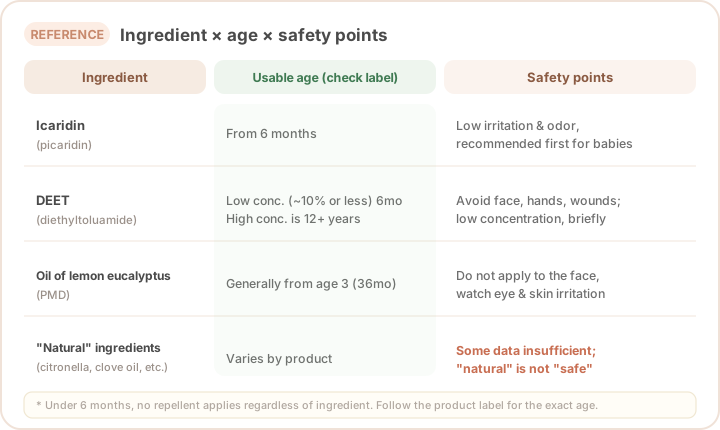
| Ingredient | Usable age (check label) | Safety points |
|---|---|---|
| Icaridin (picaridin) | From 6 months | Lower irritation & odor; often recommended first for babies |
| DEET (diethyltoluamide) | Low conc. (~10% or less) from 6 months / high conc. from 12 years | Concentration limits under 12; avoid face, hands, wounds; keep it brief |
| Oil of lemon eucalyptus (PMD) | Generally from age 3 (36 months) | Don't apply to the face; watch for eye and skin irritation |
| "Natural" ingredients (citronella, clove oil, etc.) | Varies by product | Some lack sufficient safety/efficacy data; "natural" ≠ "safe" |
Which ingredient should you choose for your baby?
Rather than memorizing every ingredient name, it's easier to decide based on your baby's age. Narrow it down with the flow below.
- Under 6 months: repellent isn't an option yet. Protect with physical barriers like a net, long clothing, and window screens.
- 6 months to around two years: if you use a repellent, the gentler icaridin tends to be recommended first. If you use DEET, use low concentration briefly, avoiding the face and hands.
- After two years, before three: you can use icaridin or low-concentration DEET according to the label age.
- After age 3 (36 months): oil of lemon eucalyptus products also enter the options per the label. Still, don't apply it to the face.
In every case the shared principle is the same: confirm it's an approved product and follow the usable age, ingredients, and instructions on the label. If choosing an ingredient is tricky or your baby's skin is sensitive, it's fine to consult a pharmacist.
How to apply repellent safely
Once age and ingredient match, just a few application rules will do. For a baby, the key is especially "thinly, and avoid what should be avoided."
- Dispense onto your own hands first, then apply thinly only to exposed skin. Rather than spraying directly on your baby, it's safer to take some on your hands and spread it.
- Avoid the face, around the eyes and mouth, and the hands. Babies often suck their hands, so anything on the hands can reach the mouth.
- Don't apply to wounds, eczema, or raw skin.
- Whether you can spray it on clothing or the stroller differs by product, so check that it's labeled for spray use.
- If using sunscreen too, apply sunscreen first, then repellent on top.
- When you get home after outdoor activity, wash off the applied areas with water. It's better not to leave it on longer than necessary.
When to consult a pharmacist or pediatrician
Most of the time, using repellent per the label is fine, but if any of the following apply, check with a pharmacist or pediatrician rather than deciding alone.
- Your baby's skin reddens or develops a reaction like hives or itching
- Repellent got into the eyes or mouth, or your baby seems to have swallowed some
- Your baby has atopic dermatitis or a skin condition, making it hard to judge which ingredient is okay
- Your baby is under 6 months but you must go somewhere with many mosquitoes and are unsure how to prepare
- You find it hard to decide which ingredient or concentration to choose
Especially if repellent gets into the eyes or mouth or your baby shows an unusual reaction, wash off the applied area and seek advice promptly. Since the response can vary with the ingredient and your baby's condition, when in doubt it's safer to have a professional see them in person.
Frequently asked questions
Can patch-type mosquito stickers be used on a baby?
Some sticker and wristband types are not approved products. Check first for approval and a labeled usable age; if there's no such labeling, it's safer not to use them on a baby.
What should I do after a mosquito bite?
The basics are to keep the baby from scratching and to soothe it by cooling. Step-by-step care for when a bite swells or oozes is in how to care for a baby's mosquito bite.
Can I reapply several times a day?
Each product labels a daily number of uses and interval. Rather than reapplying often on your own to boost the effect, follow the count and interval on the label.
We're going somewhere with lots of mosquitoes, but my baby is just under 6 months.
Under 6 months isn't a candidate for repellent, so the rule is to prepare with physical barriers like a net, long clothing, and window screens. If the situation worries you, consult a pediatrician or pharmacist in advance.
To sum up
For baby mosquito repellent, "from what age, which ingredient" is the crux. Under 6 months isn't a candidate regardless of ingredient, and physical barriers come first. After 6 months, the gentler icaridin is often recommended first for young babies, DEET is used at low concentration avoiding the face and hands, and oil of lemon eucalyptus is generally usable after age three.
Above all, rather than a "natural means safe" image, the surest way to protect your baby is the habit of confirming it's an approved product and checking the age and ingredient labeling. And when a choice is unclear, consulting a pharmacist is a good idea.