Soothing Nighttime Teething Safely — What to Do and What to Avoid
For a baby struggling with teething in the middle of the night: how to soothe safely with gum massage and a cold teether, what to absolutely avoid like benzocaine gel and amber necklaces, when to consult about pain relievers, and the warning signs that need a doctor.

When your baby suddenly cries hard in the middle of the night and keeps rubbing the gums with a fist in the mouth, you start to think, "Maybe a tooth is coming in." During the day it was manageable, but at night the baby fusses more than usual, and holding them, you reach that moment of not knowing what to do.
Let's start with the big picture. What you can safely do for nighttime teething is simpler than you might think. Gently rub the gums with a clean finger or a cold damp gauze cloth, offer a teether chilled in the fridge, and if the baby is really struggling, use a pain reliever suited to age and weight after consulting your pediatrician or pharmacist. On the other hand, methods like numbing gel applied to the gums, an amber necklace, or alcohol are best avoided, because rather than helping they can be dangerous.
In this article we will lay out, in order, the safe things you can actually do at night, the things you must never do, and the warning signs you should not brush off as teething. If you are unsure whether it is teething or a cold, see how to tell teething from a cold by the fever; if the pattern of frequent night waking itself is the worry, see the nighttime teething waking checklist.
Table of contents
- What are the basic ways to soothe safely at night?
- Pain relievers: is it okay to use them at night?
- Things you must never do
- How do you choose a safe teether and supplies?
- Signs that it needs a doctor, not teething
- Frequently asked questions
- To sum up
What are the basic ways to soothe safely at night?
The key to easing nighttime teething is "applying cool, gentle pressure to the gums." You relieve the itching and dull ache caused by a tooth pushing up through the gum with a cold sensation and steady, light pressure. Rather than medicine or a special tool, you can handle most of it with things you have at home.
Here are the safe methods you can try at night.
Method | How | What to watch for |
|---|---|---|
Gum massage | Rub the gums gently with a clean, washed finger or a cold damp gauze cloth | Check nails and hygiene; do not press too hard |
Cold teether | Offer a teether that has been chilled in the fridge | No hard items frozen solid in the freezer |
Cold damp cloth | Chill a large damp cloth and let the baby chew on one end | Avoid pieces small enough for the baby to swallow |
Cold food | For a baby who has started solids, a little age-appropriate cold food | No hard, small pieces that pose a choking risk |
Short, consistent soothing | At night, repeat a short routine of holding and patting rather than over-intervening | Soothing enough during the day makes the night easier |
There is one point to keep in mind here. Make it cold, but do not freeze it. A teether frozen solid in the freezer or hard-frozen food can actually hurt tender gums or irritate them like frostbite. A short while in the fridge, cool enough, is plenty.
At night, keeping the lights low and your voice gentle also helps. So the baby does not fully wake, repeating your soothing in short bursts is better for getting back to sleep.
Pain relievers: is it okay to use them at night?
When the baby is having an especially hard time and soothing simply will not settle them, you think of a pain reliever. To get to the point, you can use one, but only after consulting your pediatrician or pharmacist and matching it to age and weight. Even if the clinic is closed at night, checking the right dose ahead of time through a regular consultation gives you peace of mind.

Here are the basic guidelines by ingredient.
- Acetaminophen comes in infant products for relatively young ages. However, the younger the age, and especially under 3 months, you must follow a doctor's instructions, and confirm the dose after consulting.
- Ibuprofen is generally advised for use from 6 months of age and older. It is not used on your own judgment for babies younger than that.
The dose is often set by weight rather than age, so even at the same number of months it differs from baby to baby. So rather than following numbers floating around online, it is safer to confirm the right dose for your baby through a consultation. Also avoid splitting adult medicine to give, or alternating two ingredients on your own judgment.
A pain reliever is only a supportive measure for when the baby is in a lot of pain. Rather than giving it like a habit every night, think of it as getting help within the consulted range on the days the baby is truly struggling.
Things you must never do
This part is the most important in today's article. Among the folk remedies said to soothe teething, some go beyond being ineffective and actually put the baby in danger. Below are the ones official organizations advise against using.
Do not do these — the nighttime teething no-go list
- Do not apply teething gels with local anesthetic ingredients like benzocaine or lidocaine. The U.S. Food and Drug Administration (FDA) warns against using such gels on babies under 2 years old. There is a risk of methemoglobinemia, which interferes with the blood's oxygen transport, and serious cases involving infants have been investigated.
- Do not give homeopathic teething tablets containing belladonna. This is a product group for which the FDA has issued a safety warning.
- Do not put an amber teething necklace or bracelet on the baby. There is no confirmed evidence that it reduces pain, and because it is worn around the neck, it carries a risk of strangulation and choking. The American Academy of Pediatrics does not recommend it either.
- Do not rub alcohol or whiskey on the gums. Even a small amount can be dangerous for an infant.
- Do not let the baby chew on hard items frozen solid in the freezer. Freezing rather than chilling can hurt tender gums and the inside of the mouth.
- Do not raise the upper body or lay the baby on an incline because of pain. Raising the mattress angle or propping the upper body up with a pillow because the baby is fussing from teething violates safe sleep. A baby should always sleep on the back on a flat surface.
The last item is especially easy to miss. When the nose looks stuffy or the baby squirms a lot, you may want to raise the upper body, but laying the baby at an angle is linked to the risk of sudden infant death and suffocation and is not recommended. If the nose seems uncomfortable, help by putting in saline before sleep and gently clearing the mucus, and keep the sleep surface itself flat.
How do you choose a safe teether and supplies?
A teether is a reliable tool for nighttime teething, but checking a few things when you choose one can give you more peace of mind. The key is two points: whether it stays cool without freezing, and whether there is no risk of swallowing.
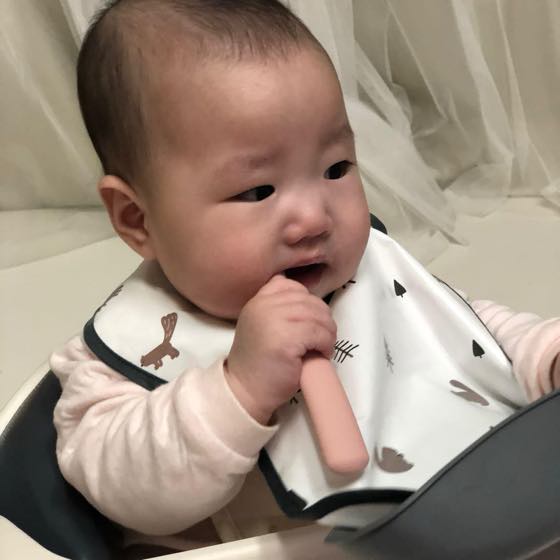
- A product that can be refrigerated but not frozen is best. A water-filled teether that hardens when frozen can leak its inner liquid if it breaks, so be especially careful.
- A one-piece shape with no small parts or detachable pieces is safe. A piece that comes off while chewing can be a choking risk.
- Avoid cords or necklace forms worn around the neck. There is a strangulation risk not only during sleep but also during play.
- Since it is something that goes in the mouth, check the material labeling, and wash it clean every day to keep it hygienic.
If you keep two or three in the fridge to rotate through at night, you can swap in a cool one right away when one gets lukewarm, which is convenient.
Signs that it needs a doctor, not teething
Teething is known to make a baby uncomfortable but not to cause a high fever or severe whole-body symptoms. So if you see signs like the ones below, do not brush it off as "it must be a tooth coming in"; it is good to have your pediatrician check whether there is another cause.
See a doctor in these cases
- A high fever of 39°C or above
- Fever or fussing lasting more than 3 days
- Diarrhea or vomiting present as well
- A rash appearing on the body
- Signs of dehydration such as reduced urine and a dry mouth
- Limp and unusually listless compared to normal
These symptoms can be linked to an infection or another problem rather than teething. Especially the younger the age, the safer it is to check the cause of a fever quickly, so when you cannot decide, we recommend seeing a doctor rather than putting it off. Detailed criteria for distinguishing teething symptoms from other causes are covered further in myths about teething.
Frequently asked questions
Is it okay to give a pain reliever every night?
Rather than using it like a habit every day, we recommend using it within the consulted range on the days the baby is truly struggling. If the baby is in enough pain to need a pain reliever every night, that itself may be a sign that a consultation is needed. Confirm the ingredient and dose with your pediatrician or pharmacist in advance.
Are teething gels really not to be used?
Gels with local anesthetic ingredients like benzocaine or lidocaine are not recommended for children under 2. If you want to give a cool sensation, a refrigerated teether or a cold damp cloth is a safer alternative to gel.
Wouldn't an amber necklace help even a little?
There is no confirmed evidence that it reduces pain, and because it is worn around the neck, it carries a risk of choking and strangulation. The benefit is uncertain while the risk is clear, so we recommend not putting one on.
Isn't a frozen teether better because it is cooler?
Frozen solid, it becomes hard and can hurt tender gums. Cool from being in the fridge is safer and more comfortable for the gums.
To sum up
What you can do for nighttime teething is surprisingly plain. Massage the gums with a clean hand or a cold gauze cloth, offer a refrigerated teether, and if the baby is really struggling, use a pain reliever within the consulted range. That is enough. On the other hand, avoid numbing gel, belladonna tablets, an amber necklace, alcohol, hard frozen items, and inclined sleeping. Soothe with something cool, but always put the baby to sleep on the back on a flat surface. Keeping just these two things makes the night much safer.
And if you see a fever of 39°C or above, or diarrhea, vomiting, a rash, dehydration, or severe listlessness, do not brush it off as teething; see a doctor. A tooth coming in is also a sign that your baby is growing, so there is no need to rush too much. This article is for information and does not replace medical care.